Music Instruments
Company
Shop By Category
T&Cs
Shop Online
  • Box contents listed
  • Free tracked Australia-wide delivery over $150
  • 14-day returns

88 key digital piano | weighted key digital piano | portable digital piano

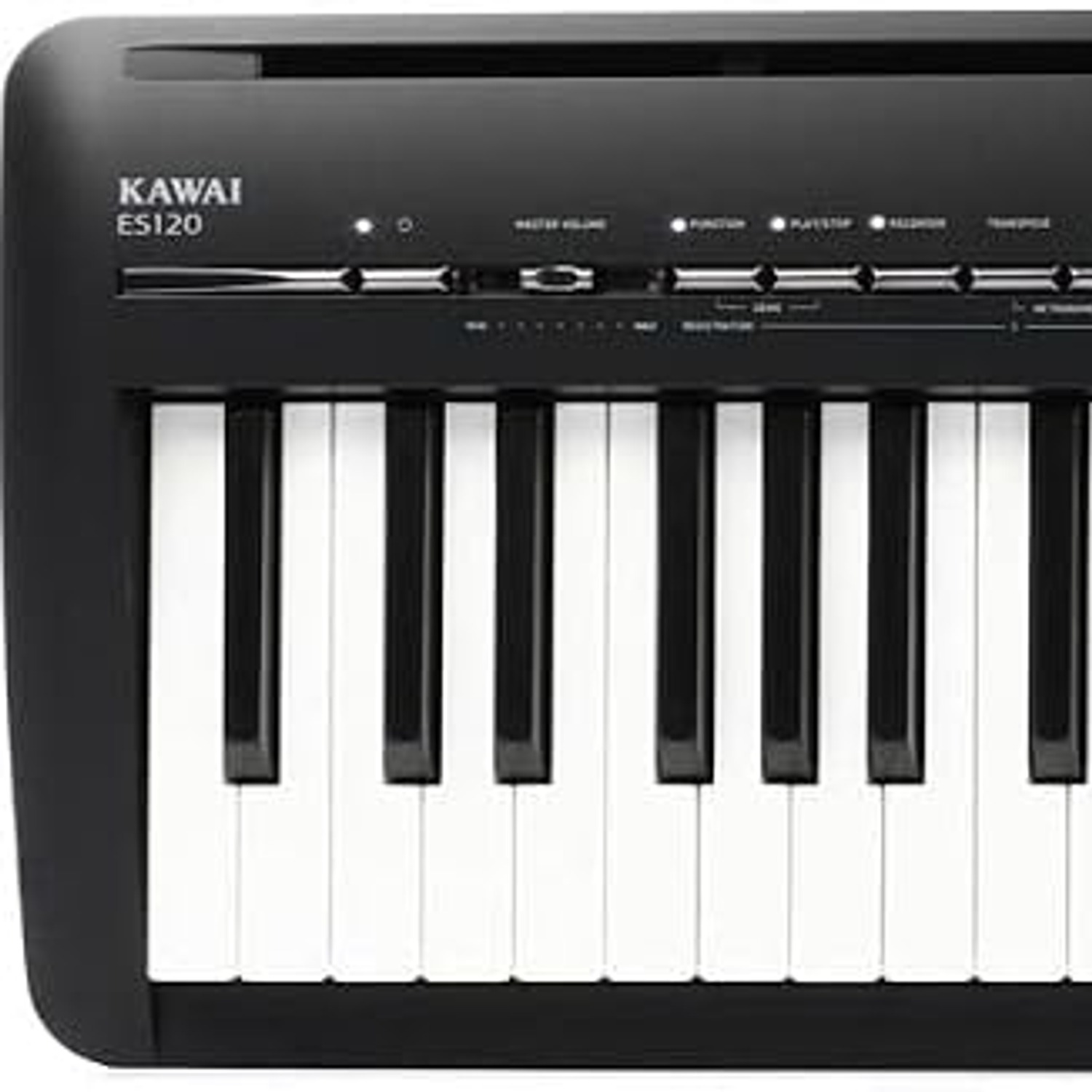
Kawai ES120 88-Key Digital Piano

$1,697.99 $2,037.99 Save $340
  • Fully Weighted Action
  • Concert Grand Tone
  • Wireless Connection
  • Easy To Move

Price: $1,697.99 $2,037.99

  • Free tracked Australia-wide delivery on orders $150+, otherwise a flat $15
  • Pay by card or PayPal, handled by the payment provider
  • 14 days to change your mind, plus your statutory rights
Product specifications
ModelKawai ES120 (ES120B)
Instrument TypeDigital Piano
Number Of Keys88
Key ActionResponsive Hammer Compact, fully weighted
Special FeaturesBluetooth audio and MIDI
Connector TypeMIDI USB
ConnectivityUSB
Headphone Jack3.5 mm
Power SourceCorded electric
Compatible SystemsmacOS, Windows
Supported SoftwareMIDI compatible software
ColourBlack
Finish TypeLacquered or polished
StyleModern
Skill LevelAdvanced
Age RangeAdult
Dimensions (D x W x H)28 x 130.5 x 15 cm
Weight12 kg
Included ComponentsES120 digital piano, F-1SP switch pedal, 3-pedal F-351 accessories
BrandKawai
ManufacturerKawai Australia Pty Ltd
Manufacturer Part NumberES120B
Country Of OriginChina
Warranty5 Year
Weight12 kg
Shipping & returns

Tracked delivery anywhere in Australia. It is free on orders of $150 or more, and a flat $15 below that.

If it is not right for you, send it back within 14 days of delivery in resaleable condition and we refund the price you paid, including standard delivery. That is a voluntary policy we offer on top of your legal rights. You cover the cost of returning it unless the item is faulty.

If it arrives faulty, damaged or not as described, we put it right at no cost to you under the Australian Consumer Law and the Competition and Consumer Act 2010, return postage included.

Shipping details · Refunds and returns

Fully Weighted ActionResponsive Hammer Compact keys with graded weighting from bass to treble.
Concert Grand ToneShigeru Kawai SK-EX sound plus 24 more voices on board.
Wireless ConnectionBluetooth audio and MIDI for apps, recording software and streaming.
Easy To Move12 kg body with stereo line outs for home practice or gigs.

Bring real grand piano touch and tone into your home with an 88 key digital piano you can actually carry.

Fully weighted Responsive Hammer Compact keys, Shigeru Kawai SK-EX concert grand sound, Bluetooth audio and MIDI, a 20W speaker system and stereo line outputs in a 12 kg body.

The ES120 gives you all 88 keys with a fully weighted hammer action, so technique you build here transfers straight to an acoustic piano.

Kawai's Responsive Hammer Compact action uses heavier hammers in the bass and lighter ones in the treble, which makes loud passages feel stable and quiet playing stay controllable.

The headline voice is the Shigeru Kawai SK-EX concert grand, backed by 24 further instrument sounds, dual and split modes, a metronome, a song recorder and 100 drum rhythms.

Built-in Bluetooth MIDI and audio connect the piano to learning apps, recording software or your phone, and a standard USB-MIDI port covers wired setups.

At 12 kg with a 20W speaker system, headphone output and left and right line outputs, it suits a quiet corner at home or a small stage.

Kawai ES120 88-Key Digital Piano

The Kawai ES120 is a full-size 88 key digital piano built around the Responsive Hammer Compact keyboard action. That action has no springs, which is part of why the key return feels even rather than bouncy, and the hammers are graded so the bass end is heavier than the treble. The practical result is a keyboard you can lean into for loud chords without it feeling loose, and still play very softly when a piece asks for it. If you have been learning on an unweighted keyboard, the difference in control is obvious within a few minutes.

Sound comes from the Shigeru Kawai SK-EX concert grand, an instrument often described as the premier piano of Japan. Alongside it sit 24 more voices, so you can switch to electric piano, strings or organ when a piece or a band arrangement calls for something else. Dual mode layers two sounds together, split mode puts a different voice in each hand, and 100 drum rhythms give you something steadier than a plain click to practise against.

Connectivity is where the ES120 earns its keep in a modern setup. Bluetooth MIDI lets it talk to learning apps and recording software on a phone, tablet or computer without cables, and Bluetooth audio streams music from your device through the piano's own speakers so you can play along. A standard USB-MIDI port is there for anyone who prefers a wired link to macOS or Windows, and Kawai's PianoRemote app gives you a visual way to change settings instead of hunting through button combinations.

For sound output you get a 20W on-board speaker system for everyday playing, a 3.5 mm headphone jack with Spatial Headphone Sound for late-night practice, and dedicated left and right line outputs for connecting to a PA, mixer or audio interface. Those line outs matter if you ever play outside the house, because sending a clean stereo signal to a desk is very different from pointing a microphone at a speaker and hoping.

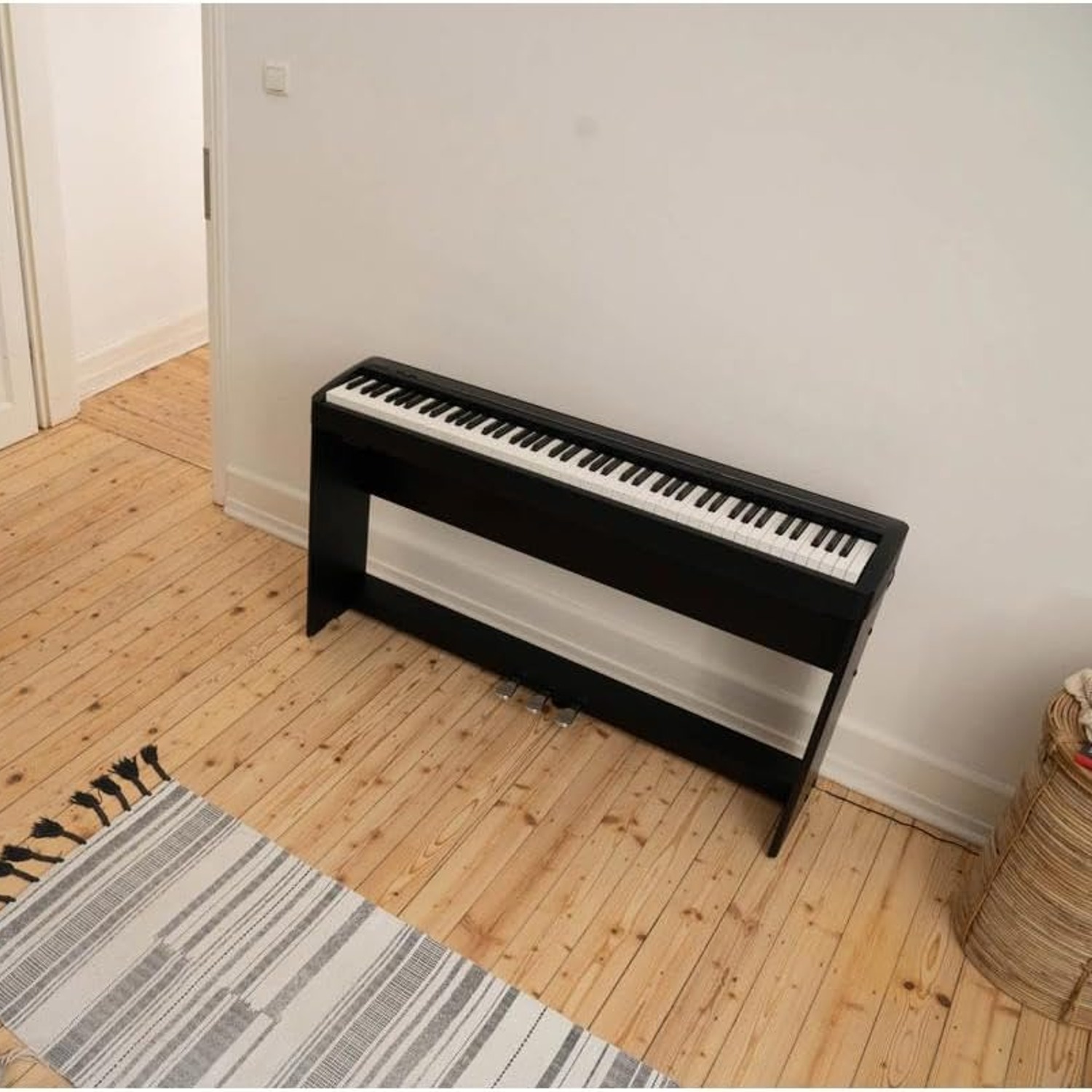
Physically, the piano measures 28 cm deep, 130.5 cm wide and 15 cm high, and weighs 12 kg. That is light enough for one reasonably fit person to carry to the car, and slim enough to sit on a desk, a sideboard or a stand without dominating a room. The package includes the F-1SP switch pedal and the F-351 three-pedal accessory, and the instrument carries a 5 year warranty. Colour is black with a lacquered or polished finish, and it is made in China.

Not sure yet? That is fine.

An instrument has to suit the player, and you cannot always judge that from a photograph. If it is not right for you, send it back within 14 days of delivery in resaleable condition and we refund the price you paid, including standard delivery. That is on top of your Australian Consumer Law rights if anything arrives faulty.

If it turns up faulty, damaged or not as described, that is on us. The Australian Consumer Law and the Competition and Consumer Act 2010 covers you, and we pay the return postage. Read the full detail on our refunds and returns page, or ask us anything before you order.

Frequently Asked Questions

What exactly is the Kawai ES120?

It is a portable 88 key digital piano from Kawai, model number ES120B. It uses a fully weighted hammer action keyboard and the Shigeru Kawai SK-EX concert grand sound, with 24 extra voices on board.

Does it have all 88 keys?

Yes. It is a full-size instrument with the standard 88 note range, the same span you would find on an acoustic grand or upright.

What does "fully weighted" actually mean?

Each key has a physical hammer mechanism behind it, so the key pushes back against your finger the way an acoustic piano key does. Unweighted keyboards use springs and feel much lighter. Weighted keys are what let you build real finger strength and dynamic control.

What is the Responsive Hammer Compact action?

It is Kawai's keyboard mechanism for this model, based on their earlier RH action. It uses no springs and has reinforced construction for consistent key motion, plus cushioning material that reduces the knocking noise keys can make.

Are the keys graded from bass to treble?

Yes. Heavier hammers are used in the lower range and lighter hammers in the upper range, mirroring how an acoustic piano is built. That grading is what makes the bass feel solid and the treble feel quick.

Is this a good first piano for an adult beginner?

It works well for that. The weighted action means you are learning on something close to a real piano from day one, and the headphone jack means you can practise without disturbing anyone. Many people hunting for the best digital piano for adult learners land on a weighted 88 note model for exactly these reasons.

Is it suitable for more advanced players?

The product listing describes it as an advanced skill level instrument, and the graded action with its fine pianissimo control is aimed at players who notice those details. Experienced pianists also tend to value the stereo line outputs and the quality of the main grand sound.

How many sounds does it have?

It has the Shigeru Kawai SK-EX concert grand plus 24 additional instrument voices, giving 25 sounds in total. There are also 100 drum rhythms you can play along with.

What are dual and split modes?

Dual mode layers two voices so both sound at once when you press a key, such as piano and strings together. Split mode divides the keyboard so your left hand plays one voice and your right hand plays another.

Does it have a metronome?

Yes, there is an adjustable metronome on board. It is one of the most useful practice tools here, especially when paired with the song recorder for checking your own timing back.

Can I record what I play?

There is a built-in song recorder for capturing your playing on the instrument itself. For more detailed recording you can send MIDI to a computer over USB or Bluetooth and use software such as a DAW.

How does the Bluetooth work?

The ES120 has both Bluetooth MIDI and Bluetooth audio. MIDI lets it communicate with learning apps and recording software wirelessly, and audio lets you stream music from a phone or tablet through the piano's own speakers.

Which apps can I use with it?

It connects to Kawai's PianoRemote control app, to third-party learning apps, and to recording software such as GarageBand. Anything that accepts standard MIDI input should be able to talk to it.

Does it work with a Mac or a PC?

Yes. The listed operating systems are macOS and Windows, and it connects over USB-MIDI as well as Bluetooth MIDI. Most MIDI compatible software will see it as a standard controller.

Can I plug in headphones?

Yes, there is a 3.5 mm headphone jack, and Kawai includes a feature called Spatial Headphone Sound that spreads the sound more naturally across the stereo field. It is a sensible pick if you want the best piano with headphone output for night practice.

How loud are the built-in speakers?

The on-board speaker system is rated at 20W. That is comfortable for a lounge room, a bedroom or a small teaching studio, and it fills the space without needing extra amplification.

Can I connect it to a PA or amplifier?

Yes. It has dedicated left and right line outputs, which give a clean stereo signal to a mixer, PA or audio interface. That makes it practical as a gigging instrument.

What pedals are included?

The package lists the F-1SP switch pedal and the F-351 three-pedal accessories. The switch pedal covers everyday sustain, and the three-pedal unit adds the extra pedals you would expect on an acoustic piano.

Does it come with a stand?

A stand is not listed among the included components in the maker's listing. Many owners use a sturdy X-stand or a matching furniture-style stand bought separately.

How much does it weigh and will I be able to move it?

It weighs 12 kg. That is light for a weighted 88 note instrument, and most adults can carry it to a car alone, though two people make loading easier if you are taking it to gigs regularly.

What are the exact dimensions?

It measures 28 cm deep, 130.5 cm wide and 15 cm high. Measure your desk or stand before ordering, and allow a little extra width for the power cable and any sheet music.

Will it fit on a desk?

At 15 cm high and 28 cm deep it sits neatly on a deep desk or a sideboard, as long as the surface is at least about 131 cm wide. Check that the desk height still leaves your forearms roughly level when you play.

Is it quiet enough for an apartment?

Plug in headphones and the speakers go silent, so the only noise left is the soft mechanical tap of the keys. That is why weighted digital pianos are so often chosen as the best digital piano for apartments.

What power does it need?

It is a corded electric instrument, so it runs from mains power using its supplied adaptor rather than batteries. Keep the cable routed where nobody can trip on it.

What colour and finish is it?

It is black with a lacquered or polished finish and a modern styling. The listing does not specify any alternative colourways for this model number.

How do I clean it?

Use a soft, dry or barely damp cloth on the keys and cabinet, then dry straight away. Skip solvents, alcohol wipes and furniture polish, and keep the piano out of direct sun and away from heaters and damp.

Is there a warranty?

Yes, the warranty description for this model is 5 years. Keep your order confirmation, as proof of purchase is normally required for any claim.

Where is it made?

The country of origin listed for this unit is China, and the manufacturer named on the record is Kawai Australia Pty Ltd.

Would it make a good gift?

It does, particularly for someone restarting piano after years away or a teenager outgrowing a small keyboard. If you are gifting it, consider adding a stand, a bench and a decent pair of headphones so the recipient can start playing the same day.

What if it turns out not to be right for me?

Keep the original packaging and get in touch with us through the contact page within the 14 day change-of-mind window counted from delivery. We will walk you through the return steps, and if the issue is a fault rather than a change of mind, the 5 year warranty applies.

Choosing an 88 Key Digital Piano, A Practical Buyer's Guide

6 min read Music Instruments

The problem with most keyboards

Plenty of people start piano on a small keyboard, get a few months in, then hit a wall. The notes run out. The keys feel like they are made of air. Pieces that should sound shaped and expressive come out flat, because the keyboard plays the same volume no matter how you touch it.

That wall is not a talent problem. It is a hardware problem. Piano technique is built on resistance, on the way a key pushes back and lets you control exactly how loud each note lands. Take that resistance away and you are learning a different instrument that happens to look similar.

An 88 key digital piano with weighted keys solves it. You get the full range, you get hammers behind the keys, and you get the quiet practice and low maintenance that make a digital instrument practical in a normal home.

How a weighted action works

Inside an acoustic piano, each key is a lever that throws a felt hammer at a string. The hammer has mass. You feel that mass every time you press a key, and your fingers learn to work with it.

A weighted digital piano copies that idea. The Kawai ES120 uses the Responsive Hammer Compact action, which puts a real hammer mechanism behind every key with no springs involved. Springs tend to make a key feel bouncy on the way back up. Removing them gives a steadier, more predictable return.

The hammers are also graded. Heavier ones sit at the bass end, lighter ones at the treble end, which is exactly how an acoustic instrument is weighted. In practice that means loud left-hand chords feel planted rather than skittish, and fast right-hand runs do not drag. Kawai has also added cushioning material in this action to cut down the mechanical knock that key beds can make, which matters more than you would think when you are playing at 11pm with headphones on and everyone else is asleep.

Sound, and why the source matters

A digital piano's tone comes from recordings of a real instrument. The quality of that source recording sets the ceiling for everything else.

The ES120 is built on the Shigeru Kawai SK-EX concert grand, an instrument with a strong reputation among concert pianists in Japan and beyond. You hear that in the bloom of a sustained chord and in how the tone changes as you play harder, rather than just getting louder.

Around it sit 24 more voices. Electric pianos for pop and jazz, strings for layering, organ, and so on. Dual mode stacks two of them together. Split mode gives each hand its own sound, which is handy for teaching or for playing bass lines with the left hand. There are 100 drum rhythms too, and practising to a groove instead of a bare click is a surprisingly effective way to tighten up your timing.

The on-board speakers are rated at 20W, enough for a room without needing an amp. Through headphones you get Spatial Headphone Sound, which spreads the stereo image so it feels less like the music is stuck between your ears.

Who this piano suits

Three groups tend to get the most out of an instrument like this.

Adult learners and returners, first. If you played as a kid and want back in, a weighted 88 note piano means you are not relearning touch later. The headphone output means practice fits around a household rather than fighting it. People shopping for the best digital piano for home usually arrive at this specification.

Students working toward exams, second. Graded syllabuses assume full range and dynamic control, and this instrument gives you both. The metronome and song recorder are genuinely useful here, because hearing your own playing back is how you find the bits you have been glossing over.

Gigging and semi-pro players, third. At 12 kg with dedicated left and right line outputs, this is a realistic stage instrument. A clean stereo feed into a mixer sounds far better than a microphone pointed at a speaker, and the weight means you are not dreading load-in. Anyone comparing the best gigging digital piano options will be weighing exactly those two things.

How to choose, practically

Start with space. The ES120 is 130.5 cm wide, 28 cm deep and 15 cm high. Measure the spot you have in mind, allow for the power cable at the back, and allow room for music or a tablet. Most 88 key instruments land near this width, so if it will not fit, no full-size piano will.

Then think about the stand. A stand is not listed in the included components for this model, so budget for one. A solid X-stand works if you move the piano often. A fixed furniture-style stand looks better and feels steadier if the piano lives in one room. Either way, pick one rated well above 12 kg so it does not flex when you play hard.

Next, the bench. Height matters more than people expect. You want your forearms roughly parallel with the floor and your wrists relaxed. An adjustable bench sorts this out for players of different sizes sharing one instrument.

Headphones are the last piece. Closed-back over-ear headphones with a 3.5 mm plug work straight into the jack and keep sound in. Cheap earbuds will undersell the instrument badly, so it is worth spending a little here.

Finally, check how you want to connect. Bluetooth MIDI handles wireless links to learning apps and recording software. Bluetooth audio streams backing tracks from your phone through the piano speakers. A standard USB-MIDI port covers wired connections to macOS or Windows, which some people prefer for recording because there is no pairing to think about. Kawai's PianoRemote app gives you a screen-based way to change settings rather than memorising button combinations.

Looking after it

Digital pianos are low maintenance, but a few habits keep one looking and feeling new.

Wipe the keys with a soft cloth that is dry or barely damp, then dry them immediately. Avoid solvents, alcohol wipes and furniture polish, since they can dull or craze key surfaces over time. Dust the cabinet the same way.

Position matters too. Keep the piano out of direct sunlight, away from radiators and heaters, and out of damp rooms. Electronics and damp air are a poor combination. If the instrument sits unused for a while, cover it, and unplug the adaptor during storms or when you are away for a long stretch.

Keep drinks off the top panel. It sounds obvious. It is also the single most common way a perfectly good instrument gets ruined.

The short version

The Kawai ES120 is a full 88 key digital piano with a fully weighted, graded hammer action, built around the Shigeru Kawai SK-EX concert grand sound plus 24 extra voices. It has Bluetooth audio and MIDI, USB-MIDI, a 20W speaker system, a 3.5 mm headphone jack with Spatial Headphone Sound, and stereo line outputs for stage use.

It is 130.5 cm wide and weighs 12 kg, comes in black with a lacquered or polished finish, ships with the F-1SP switch pedal and F-351 three-pedal accessory, and carries a 5 year warranty.

If you want an instrument that teaches proper technique, stays quiet when the house is asleep, and can still be carried out to a gig, this is the shape of piano to look at. Measure your space, add a stand and a decent pair of headphones, and you are set.

Browse the shop

Not sure if it fits your space?

Send us your room measurements or your playing goals and we will tell you honestly whether this piano is the right match.

Ask us a question

Page summary

The Kawai ES120 (model ES120B) is an 88 key digital piano with a fully weighted Responsive Hammer Compact action and graded hammer weighting. Its main voice is the Shigeru Kawai SK-EX concert grand, with 24 additional sounds, dual and split modes, a metronome, a song recorder and 100 drum rhythms. It has Bluetooth audio and MIDI, a USB-MIDI port, a 3.5 mm headphone jack with Spatial Headphone Sound, a 20W speaker system and stereo line outputs, and works with macOS and Windows MIDI software. It measures 28 x 130.5 x 15 cm, weighs 12 kg, is black with a lacquered or polished finish, is made in China, ships with the F-1SP switch pedal and F-351 three-pedal accessory, and carries a 5 year warranty. Polyphony count and included stand are not specified in this record.