
The complete guide
Choosing a 27 Note Glockenspiel - A Practical Buyer's Guide
The problem with starting an instrument
Most instruments punish you for the first few months. A violin squeaks. A clarinet refuses to make a sound at all until the reed and the mouth agree. A guitar hurts your fingertips and sounds like a rubber band until the chords clean up. Plenty of people quit in that window, not because they lack talent but because nothing they do produces anything they want to hear.
Tuned percussion skips all of that. You pick up a mallet, you hit a bar, and a clean, in-tune note rings out. Nothing to adjust, nothing to breathe into, no callouses required. That first sound is already musical, and from there the only question is which bar comes next. It is why schools reach for tuned percussion first, and why a 27 note glockenspiel is such a sensible choice for an adult who has quietly wanted to play something for years.
How a glockenspiel actually works
The mechanism is simple enough to explain in a paragraph. A row of metal bars is cut to different lengths and thicknesses. Shorter, thinner bars vibrate faster and sound higher. Longer, thicker ones vibrate slower and sound lower. Each bar rests on supports placed at the points where it barely moves, so the bar can ring freely instead of being damped by the frame beneath it. Strike it with a mallet and the whole bar vibrates at a fixed pitch.
That is why there is no tuning. The pitch comes from the physical shape of the metal, and metal does not drift the way a stretched string does. Barring physical damage, the instrument you unpack will sound the same in ten years.
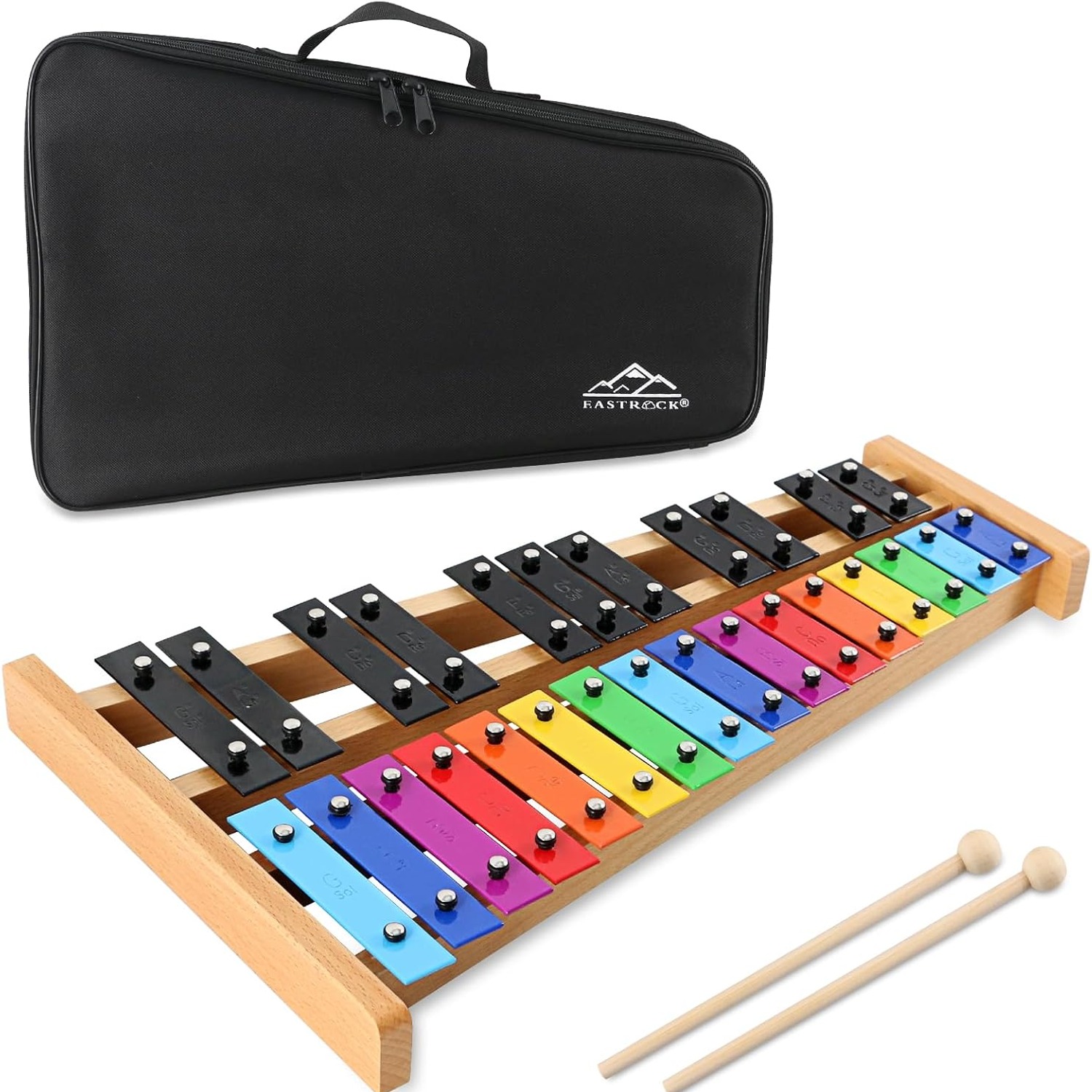
The frame matters too. Here the bars sit on a wooden body, and the choice of timber over moulded plastic is not just cosmetic. Wood gives a little back to the sound, rounding off the hardest part of the attack and leaving a warmer tail. The manufacturer describes the result as clear, resonant, warm and pleasant, and that is a fair description of what a well-made wooden-framed set does compared with a cheap metal toy.
Why 27 notes is the number that matters
Range is where beginner instruments usually fall short. A lot of entry-level sets have 8, 13 or 15 bars. Those are fine for scales, for nursery rhymes and for banging out a tune with one finger, but you hit the ceiling fast. Try to play a real melody and you will run out of notes somewhere in the second line.
Twenty-seven notes gives you two complete octaves, including every sharp and flat. That is the point where the instrument stops being a learning toy and starts being a usable musical tool. Folk tunes fit. Hymns fit. Most pop melodies fit. Exam pieces for early percussion grades fit. You can transpose into a comfortable key instead of being forced into whichever key the instrument happens to allow.
Two octaves also means you can play melody and a simple harmony line without crossing over yourself constantly. With the two wooden mallets supplied, two-note intervals are easy once your hands learn the spacing.
The keyboard layout is a hidden lesson
Look at the bars from above and you will see the shape of a piano. Naturals in a continuous row, sharps and flats raised and grouped in twos and threes. This is not decoration. It is the same spatial map that underpins piano, organ, accordion and most written music theory.
A child who spends a year playing melodies on a glockenspiel is quietly learning where B flat lives, how a major scale is spaced, and why some intervals look wide and sound narrow. Sit them at a piano afterwards and they are not starting from zero. The same applies to an adult. If you are considering the best wooden xylophone with mallets as a stepping stone to keyboard, the layout is doing half the teaching for you.
Who it suits
Students are the obvious group. A beginner with a private teacher or a school programme gets an instrument that sounds good immediately and covers the range their material needs.
Music teachers are the second group, and the carry case is the reason. Teachers who move between rooms, visit schools or run community groups need gear that packs down and travels. Everything here lives in one suitcase-style case with a handle, mallets included, which removes the most common pre-lesson scramble.
Then there are hobbyists and home recordists. Glockenspiel is a studio favourite for adding sparkle to a mix. It sits above guitar and piano without fighting them, and a two octave instrument gives you enough room to follow a vocal line rather than just ping out single notes.
Finally, families. A 3.5 kg instrument in a case can live in a cupboard and come out for half an hour. That is very different from a piano, which demands floor space and a decision.
How to choose between glockenspiels
A few things separate a good set from a disappointing one.
Check the bar count against what you actually want to play. If someone intends to work through real repertoire, anything under two octaves will frustrate them within months.
Look at the frame material. Wood costs more to build than plastic and gives a better tone. It also tends to indicate a manufacturer taking the instrument seriously rather than selling a novelty.
Ask what is in the box. Mallets are not always included, and buying them separately adds cost and a delay. Here two wooden mallets come with the set.
Think about storage and transport honestly. If the instrument has no case, it will end up on a surface collecting dust, or in a drawer getting scratched. A case is the difference between an instrument that gets played and one that gets forgotten, which is why many buyers specifically look for the best glockenspiel with carry case rather than the cheapest bare set.
And check the warranty. This one carries a 2-year warranty, which is a reasonable signal about expected life.
Looking after it
Care is undemanding. Wipe the bars with a dry or barely damp cloth after playing and dry them straight away, because sitting moisture is the main enemy of metal keys. Skip the household cleaners and solvents entirely.
Keep the wooden frame away from radiators, direct sun and damp rooms. Timber moves with heat and humidity, and a stable indoor spot will keep everything sitting true.
Use the supplied mallets rather than improvising with drumsticks or kitchen utensils. Hard metal objects can dent a bar, and a dented bar can change tone permanently.
Put the whole set back in its case between sessions. Dust off the bars, mallets accounted for, frame protected. It takes five seconds and saves a lot of annoyance later.
The short version
A 27 note glockenspiel hits a useful middle ground. It is forgiving enough that a complete beginner sounds decent in the first minute, and large enough that the same player is still using it two years later. The metal bars never need tuning. The wooden frame warms the tone. The keyboard-style layout teaches note positions without anyone having to explain them.
This EASTROCK set includes two wooden mallets and a suitcase-style carry case, weighs 3.5 kg, is made in China and carries a 2-year warranty. Overall dimensions are not listed in the product record, so ask if you need an exact footprint. Everything else you need to start is already in the box.